
The Carter Center’s decades-long fight against an ancient parasite affecting some of the world’s poorest may soon end in a victory.
After leaving the White House, former President Jimmy Carter made the eradication of Guinea worm a top mission of the Carter Center, the nonprofit he and his wife, Rosalynn Carter, founded. Even after entering home hospice care in 2023, aides said Carter kept asking for Guinea worm updates.
Rarely fatal but searingly painful and debilitating, Guinea worm disease infects people who drink water tainted with larvae that grow inside the body into worms as long as 3 feet. The noodle-thin parasites then burrow their way out, breaking through the skin in burning blisters.
To get rid of the parasite, worms have to be gently wound around a stick as they’re slowly pulled through the skin. Removing an entire worm without breaking it can take weeks.
When the Carter Center started leading the global Guinea worm eradication campaign, an estimated 3.5 million people in 21 African and Asian countries were afflicted with the disease. On World NTD Day on Friday, the center announced that there were only 10 human cases reported across the world.
The center said two of the provisional cases were detected in South Sudan, four in Chad, and four in Ethiopia.
These numbers remain provisional until they are officially confirmed by each country during the campaign’s annual meeting, which is usually held in April.
Eddie Mullholland-WPA Pool / Getty Images
“President Carter always said he wanted to outlast the last Guinea worm. While he didn’t quite get his wish, he and Mrs. Carter would be proud to know there were only 10 human cases reported in 2025. And they would remind us that the work continues until we reach zero,” said Carter Center CEO Paige Alexander.
Defeating a disease through persuasion
Guinea worm would be the second human disease to be eradicated in history, following smallpox. Remarkably, it’d be the first without a medicine or vaccine.
Instead of finding a cure, the campaign sought to break the worm’s life cycle in communities suffering from the parasite —persuading millions to change their behavior.
Workers from the center and host governments trained volunteers to teach neighbors to filter water through cloth screens, removing tiny fleas that carry the larvae. Villagers learned to watch for and report new cases — often for rewards of $100 or more. Infected people and dogs had to be prevented from tainting water sources.
Louise Gubb/Corbis via Getty Images 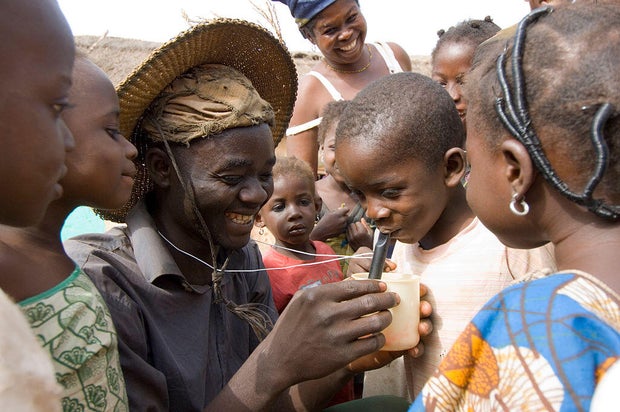
Health workers investigate every report of the disease. The Carter Center says there were more than 1 million rumors investigated in 2025, most within 24 hours of notification.
“This campaign reflects the values that shaped my grandparents’ lives — the conviction that hope, hard work, and respect for everyone can change the world. Seeing Guinea worm cases reach historic lows is one of the clearest expressions of that legacy and our commitment to the communities where trust has been earned,” said Jason Carter, the Carter Center board chair and eldest grandchild of Jimmy and Rosalynn.
Jimmy Carter made eradication a personal mission
Mr. Carter’s fundraising enabled the center to pour $500 million into fighting Guinea worm. He persuaded manufacturers to donate larvicide as well as nylon cloth and specially made drinking straws to filter water. His visits to afflicted villages often attracted news coverage, raising awareness globally.
“He went to so many of the localities where people were afflicted,” said Dr. William Brieger, a professor of international health at Johns Hopkins University who spent 25 years in Africa. “The kind of attention that was drawn to him for getting on the ground and highlighting the plight of individual people who were suffering, I think that made an important difference.”
Maggie Fick / AP 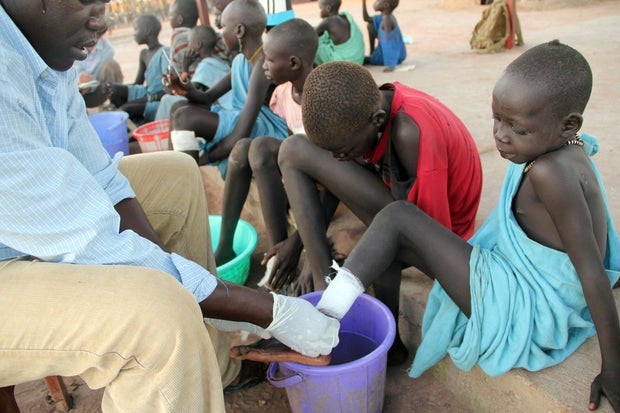
Carter first saw the disease up close in 1988 while visiting a village in Ghana where nearly 350 people had worms poking through their skin. He approached a young woman who appeared to be cradling a baby in her arm.
“But there was no baby,” Carter wrote in his 2014 book “A Call to Action.” “Instead, she was holding her right breast, which was almost a foot long and had a worm emerging from the nipple.”
Carter used his status to sway other leaders to play larger roles. Some heads of state got competitive, spurred by the center’s charts and newsletters that showed which countries were making progress and which lagged behind.
Visiting a hospital packed with suffering children and adults amid a 2007 resurgence in Ghana, Carter suggested publicly that the disease should perhaps be renamed “Ghana worm,” which pushed the country’s leaders to take action. Ghana ended transmission within three more years.
The World Health Organization’s target for eradication is 2030. Carter Center leaders hope to achieve it sooner.
The Associated Press contributed to this report.