
NEWYou can now listen to Fox News articles!
“Okay, hi everyone. I’m Janie,” says a curly-haired, bespectacled redhead, clasping her hands in front of her as she shyly addresses a camera from her dorm room.
“It’s day one of rush at the University of Alabama,” Janie continues. Then, she lists off where she got each item of clothing she’s wearing: a pleated skirt from Abercrombie, a knit top from J. Crew, socks from Target and sneakers from Nike.
It’s Janie B’s first video on her TikTok account, @jani.b086, and it’s a hit. The video, posted on Aug. 8, has since amassed over 120,000 views. Its comment section is full of users doting over the college freshman — the word “adorable” is used by at least a dozen commenters.
Janie’s “outfit of the day” video, known online as an “OOTD,” is a popular video format for the thousands of potential new members (PNMs) who document their experience going through the recruitment process for college sororities in an annual TikTok phenomenon known as “RushTok.”
PARENTS DROP EYE POPPING FEES ON SORORITY RUSH COACHES TO GET KIDS INTO ELITE COLLEGE GREEK LIFE
New Alpha Gamma Delta sorority sisters at the University of Alabama run to their sorority house after opening their bids inside Bryant-Denny Stadium in Tuscaloosa, Ala., on Aug. 15, 2026. (USA TODAY Network via Reuters Co)
But Janie isn’t like the other RushTok girls who vlogged their Bama Rush experience this year. She doesn’t go to the University of Alabama. She didn’t rush a sorority. She didn’t even get her top from J. Crew or her sneakers from Nike.
That’s because Janie isn’t real.
Every detail of every video on Janie’s account, from her dorm room, to her outfits, to Janie herself, was generated by artificial intelligence.
Olivia Moore, an investment partner at venture capital firm Andreessen Horowitz, created Janie as an experiment to understand how consumers react to AI-generated content. For only $100 in credits, Moore produced a week’s worth of videos of her fake RushTok influencer participating in Bama Rush and observed as her audience argued whether Janie was real or not.
The experiment showed how quickly some viewers could detect AI-generated content and how willing some were to continue watching even after they knew Janie wasn’t real.
Designing the Janie B. experiment
Moore is on the consumer investing team at Andreessen Horowitz where she invests in companies building consumer AI products. She says she has been fascinated by “how people make and interpret and understand AI content.”
“The image, video, audio models are getting very human-like, very fast. I think we probably cross the uncanny valley in the next six months,” Moore said in an interview with Fox News Digital.
“And so it means that how we as humans are able to detect AI-generated or AI-assisted content and how we interact with it is just going to become even more important because we’re going to have a flood of this content, and it’s going to be, in many cases, indistinguishable across all of our channels,” she continued.
Moore said she created Janie as an experiment to see how consumers react to AI.
“Philosophically, that’s an interesting question for me. What do people feel about AI content? What do they feel when they don’t know it’s AI? What do they feel when something they liked, or loved, or hated or were interested in turned out to be AI?”
CALIFORNIA LAW PUTS DIGITAL FINGERPRINTS ON AI FAKES
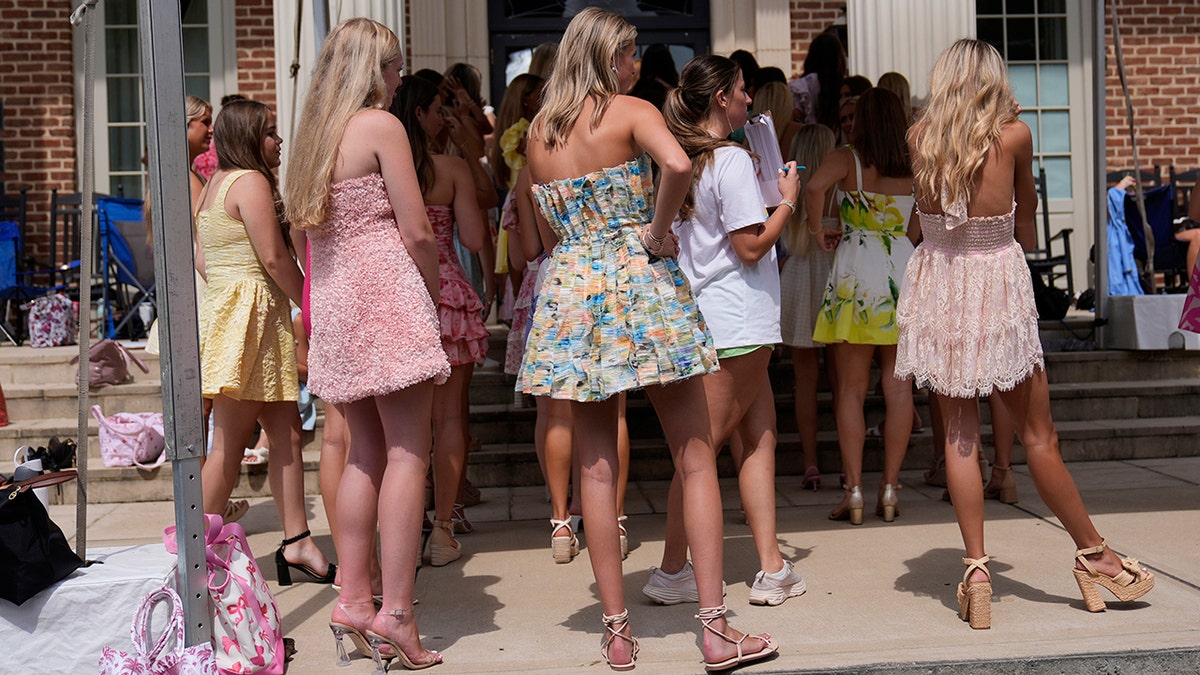
Recruitment prep has become its own industry, with coaches, social media strategists and designer wardrobes. (AP Photo/Brynn Anderson)
Moore primarily used ChatGPT and MiniMax to breathe life into her fake influencer. She pulled a real video of a University of Alabama dorm room off of the internet and uploaded it to ChatGPT. Then, she prompted Janie to have frizzy red hair, a pair of glasses and style from the 1960s. ChatGPT produced a still image of Janie in the real dorm room photo, and the “RushTok” influencer was born — or generated, at least.
For each TikTok, Moore animated Janie by feeding the still dorm room image into AI video model MiniMax H3. She used ChatGPT to produce prompts to feed into MiniMax, shaping how Janie would move, what she would sound like and the scripts she would follow.
Moore chose RushTok to introduce her AI influencer to the world after watching the annual phenomenon for the past five years. She said it was “the perfect testing ground” for her experiment for several reasons. Janie wouldn’t be selling anything or hurting anyone, and RushTok naturally draws high traffic and has a low barrier to entry for new creators. With other PNMs participating in the trend, audiences would experience Janie alongside real humans posting similar content.
Could TikTok tell Janie was AI-generated?
On the first day of Alabama Rush, Moore introduced Janie to the world with an OOTD video. Reactions to Janie were split in the comments.
“I would say anyone under maybe 25 immediately clocked her as AI,” Moore said. “But anyone in the older demographic, which is much of the Bama Rush audience, was, I would say, fooled by her and just wishing her luck and sending her good thoughts in the process.”
By the second day of the experiment the audience was mostly onto her. Moore said people took to Reddit to discuss Janie, created commentary videos on TikTok and corrected anyone who thought Janie was real in her comment section.
“By day two, day three, the comments were filled with still some people who were saying really nice things. And people would comment and tell them, ‘Hey, this is AI.’ And they’d be like, ‘I don’t care. She seems so sweet. Like I want her to succeed.'”
As the audience caught on, Moore said she had to change her strategy. She realized that people were still willing to watch AI-generated content as long as it was entertaining enough. So, she started dropping hints in the videos and watched as digital sleuths would proudly point out clues in her comment section.
CNN, NBC, CBS INTERVIEWING VIRAL AI ‘ACTRESS’ TILLY NORWOOD RAISES EYEBROWS AMONG CRITICS

New Alpha Omicron Pi sorority sisters at the University of Alabama run to their sorority house after opening their bids inside Bryant-Denny Stadium in Tuscaloosa, Ala., on Aug. 15, 2026. (USA TODAY Network via Reuters Co)
Moore said that humans are getting better at detecting AI quicker than AI generation is improving.
“We’re kind of in a graph with two competing lines of different slopes. So one of them is like, how fast is AI approaching true human-like quality? And that has gotten a lot better over the past year. The other line is how fast are humans getting better at detecting AI?” Moore said. “It seems like, at least for now, that latter curve is higher slope. It’s inflecting faster. The average human can still tell an AI video from a truly human video.”
While humans could generally detect the AI content, Moore claimed TikTok , for the most part, did not immediately detect AI in most of the videos.
For the experiment, Moore decided to not label her videos as AI when she uploaded them. Of the 20 AI-generated videos she uploaded, Moore said TikTok only initially flagged 8 as containing AI-generated media. As of the date of this publication, TikTok displays an AI-generated media warning on 16 of the 20 AI videos.
“The platforms themselves are going to have a hard time detecting this content at scale, especially when the models are changing and the strategies are changing, and people are always gonna find ways to make this undetectable,” Moore said.
What does the Janie B. experiment mean for the future of AI media?
Moore ended her experiment with a video of herself explaining to the audience who she was and why she decided to create Janie. She was shocked by the positive comments she received on the post.
“I think consumer sentiment towards AI is still quite negative. But if people feel like they aren’t being tricked, they’re being let in on it, they are being told how to do this themselves, they’re being entertained by the content that’s created, that can completely flip and the feelings can be very, very positive,” Moore told Fox News Digital.
Moore predicts that more consumers will start using AI tools to create human-passing content, but she says it will have to compete with human content to gain emotional investment and be as interesting and entertaining to viewers.
“I understand why people are fearful of AI because, so far, if they see AI content, it’s usually something that’s kind of trying to trick them versus something that is honest with them and shows them how they could get the same value,” said Moore.
“The more that we are kind of honest and straightforward as people using AI around how we use it and how much of us as humans still goes into that, it’ll hopefully lead to a world where AI is just another tool that allows humans to do things that are even more human.”
CLICK HERE TO DOWNLOAD THE FOX NEWS APP
The Alabama Panhellenic Association declined to comment on Moore’s experiment.